
Demand Regenerative Skin Treatments in 2026


Most In-Demand Regenerative Skin Treatments in 2026
Regenerative aesthetics is moving toward treatments that improve skin quality, collagen production, elasticity, texture, and tissue repair rather than simply adding facial volume.
The treatments receiving the greatest attention are:
1. Microneedling and RF Microneedling
These remain among the most widely requested regenerative skin procedures.
Common treatment goals:
Acne-scar improvement
Fine-line reduction
Enlarged-pore refinement
Skin tightening
Improved texture and tone
Collagen and elastin stimulation
Standard microneedling creates controlled microchannels. RF microneedling adds radiofrequency energy beneath the skin, producing controlled thermal stimulation at selected depths.
Because RF microneedling penetrates living tissue and uses an energy-based medical device, it generally requires substantially more clinical training and oversight than a superficial cosmetic facial.
2. PRP and PRF Skin Rejuvenation
Platelet-rich plasma, or PRP, and platelet-rich fibrin, or PRF, use components prepared from the patient’s own blood.
They are commonly used for:
Facial rejuvenation
Under-eye improvement
Acne scars
Skin texture
Hair-restoration procedures
Combination treatments with microneedling or laser resurfacing
PRP and PRF continue to be central procedures in regenerative aesthetics because they use autologous, patient-derived material. However, preparation methods, platelet concentration, centrifugation protocols, and application techniques vary considerably. (American Society of Plastic Surgeons)
These are medical procedures, not ordinary esthetic services, because they involve blood collection, blood processing, possible injections, medical assessment, infection-control responsibilities, and management of adverse reactions.
3. Biostimulatory Injectables
Biostimulators encourage the body to gradually produce additional collagen. Frequently discussed products include:
Poly-L-lactic acid, such as Sculptra
Calcium hydroxylapatite products
Hyperdilute biostimulatory protocols
Unlike traditional hyaluronic-acid filler, these products are often selected for gradual collagen support, skin firmness, facial structure, and longer-term tissue improvement.
The FDA has approved Sculptra for specific indications, including correction of cheek wrinkles in appropriate adult patients. This does not mean every body area, dilution, technique, or advertised use is FDA-approved. (U.S. Food and Drug Administration)
Biostimulator education should be treated as advanced injectable training, not an introductory filler class.
4. Fractional Laser Resurfacing
Fractional non-ablative and ablative resurfacing treatments remain important regenerative modalities.
They may be used for:
Photoaging
Fine lines
Acne scars
Uneven pigmentation
Rough skin texture
Collagen remodeling
CO₂ and other ablative lasers create a much more substantial tissue response than basic facial devices. Training must include laser physics, skin typing, treatment depth, wound care, pigmentation risks, ocular safety, burns, scarring, and emergency management.
5. Combination or “Stacked” Treatment Plans
A major current trend is not one isolated procedure, but a carefully sequenced combination of treatments.
Examples include:
RF microneedling plus PRP
Fractional laser plus platelet-based treatment
Biostimulator plus energy-based tightening
Microneedling plus a professional post-procedure protocol
Laser resurfacing followed by barrier-repair skincare
Combination treatment can produce better results, but it can also increase inflammation, infection risk, pigment alteration, delayed healing, and other complications. Students must learn treatment sequencing, not merely how to operate each device.
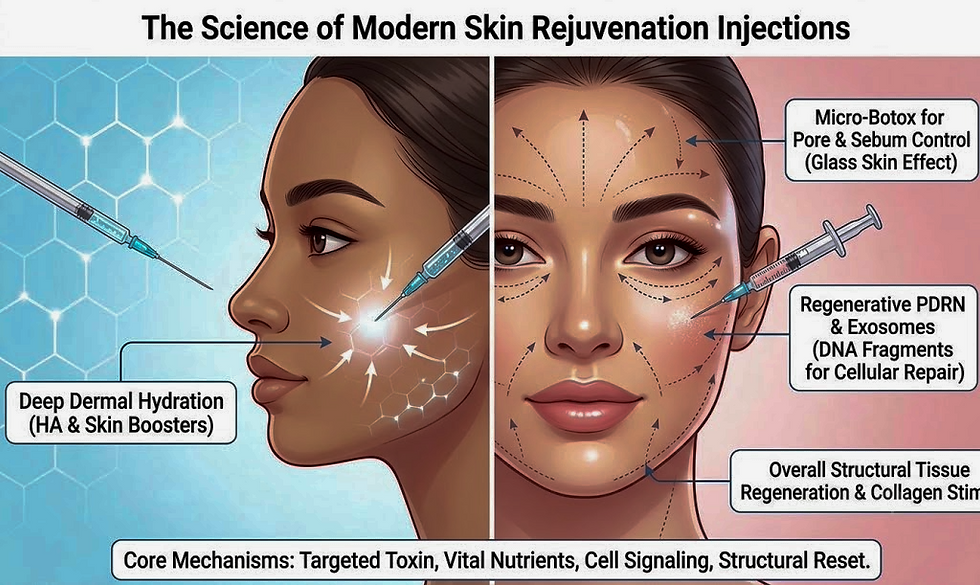
6. Polynucleotides and Injectable Skin Boosters
Polynucleotides, injectable hydration products, and “bio-rejuvenation” treatments are receiving strong international attention. Early literature reports potential improvements in elasticity, fine lines, and skin quality, but products and regulatory status differ significantly between countries. (PMC)
A product used in Korea, Europe, or another country should not automatically be assumed lawful or approved for injection in the United States.
Before teaching or administering one of these products, a school or clinic should verify:
FDA status
Product labeling
Legal distribution
Intended use
Prescriber responsibility
Texas delegation requirements
Professional liability coverage
7. Exosome Products
Exosomes are heavily promoted in regenerative aesthetics, particularly after microneedling, laser treatment, and hair-restoration procedures.
However, this category requires serious caution.
The FDA states that there are currently no FDA-approved exosome products. Clinics and schools should not represent an exosome product as FDA-approved merely because it is sold as a serum, research product, cosmetic product, or post-procedure treatment. (U.S. Food and Drug Administration)
For an educational institution, exosomes may be discussed in a theory module covering emerging technology, evidence, regulatory risk, product verification, and informed consent. They should not be marketed as an established, approved injectable regenerative treatment.
What Training Is Required?
There is no single certificate called a “regenerative aesthetics license.” The necessary education depends on:
The practitioner’s underlying professional license
Whether the skin is penetrated
Whether blood is drawn or processed
Whether medication or a biological substance is injected
Whether a prescription medical device is used
The depth and intensity of the treatment
Texas medical delegation and supervision requirements
A weekend certificate does not independently authorize someone to perform a medical procedure.
Training for Licensed Estheticians
A Texas esthetician completes a 750-hour licensing program, but the license does not automatically authorize medical procedures. (Texas Licensing and Regulation)
Appropriate advanced education for an esthetician may include:
Advanced skin anatomy and physiology
Cosmetic skin analysis
Fitzpatrick skin typing
Barrier repair
Superficial exfoliation
Pre- and post-procedure skincare
Infection control
Contraindication recognition
Client education
Referral criteria
Assisting appropriately within a medical practice
Texas distinguishes cosmetic exfoliation from procedures that contact or penetrate living dermal tissue. Deeper procedures that penetrate the dermis do not fall within the ordinary esthetician scope and must be performed under appropriate medical authority. (Texas Licensing and Regulation)
Therefore, an esthetician certificate in PRP, injections, deep microneedling, or medical laser treatment does not by itself create legal authority to perform the service.
Training for RNs
Registered nurses may participate in nonsurgical medical cosmetic procedures when the procedure falls within nursing scope, the RN has documented competency, and the procedure is properly ordered or delegated.
Texas nursing guidance emphasizes that an RN should not perform a cosmetic procedure without the required education, knowledge, competency, and appropriate medical delegation. (Texas Board of Nursing)
A regenerative-aesthetics course for RNs should include:
Facial and vascular anatomy
Skin and wound-healing physiology
Patient assessment
Medical history and contraindications
Bloodborne-pathogen precautions
Venipuncture
PRP and PRF preparation
Centrifuge operation and quality control
Aseptic technique
Microneedling and RF-microneedling protocols
Injectable complications
Vascular occlusion recognition
Infection and biofilm prevention
Emergency response
Documentation and photography
Informed consent
Texas delegation requirements
Supervised clinical procedures
Competency validation
An RN should also maintain current BLS certification. Advanced emergency education is advisable for injectors and providers working in medical-aesthetic settings.
Training for APRNs and PAs
APRNs and PAs may have broader assessment and treatment responsibilities, but they must still operate within their professional scope, prescriptive authority, facility protocols, and applicable physician relationships.
Recommended education includes everything in the RN curriculum, plus:
Differential assessment of skin conditions
Pharmacology
Product selection
Treatment planning
Prescription-device requirements
Management of complications
Standing orders and delegation
Medical record standards
Emergency medication protocols
Training for Physicians
Physicians providing or delegating regenerative procedures should receive product-specific and procedure-specific education, particularly when introducing unfamiliar technologies.
Important competencies include:
Patient diagnosis and candidacy determination
Good-faith medical evaluation
Treatment ordering
Delegation and supervision
Complication management
Emergency availability
Protocol approval
Quality assurance
Staff competency review
In Texas, injections for cosmetic purposes and the use of prescription medical devices for cosmetic procedures are considered the practice of medicine. These acts may only be delegated to appropriately trained persons under compliant medical oversight. (Texas Municipal Bureau)

Recommended Training Program for ALAI
For the American Laser & Aesthetics Institute, I would recommend creating a tiered program rather than one general class.
Level 1: Regenerative Skin Science
cosmetologists, nurses, and other professionals, this foundational module explores the core science behind modern regenerative skin treatments with clear scope-of-practice distinctions.
Topics:
Skin anatomy and wound healing
Collagen and elastin physiology
Inflammation and tissue remodeling
Regenerative skincare ingredients
Barrier preparation and recovery
Patient selection
Contraindications
Treatment documentation
Regulatory and ethical boundaries
This level should be educational and non-injectable.
Level 2: Advanced Microneedling and RF Microneedling
Device physics
Needle depth and tissue response
Facial danger zones
Skin-type assessment
Acne-scar protocols
Pigmentation risks
RF parameters
Sterile setup
Post-treatment care
Adverse-event management
Supervised hands-on practice
Admission should be restricted according to the procedure, device classification, professional license, and medical delegation requirements.
Level 3: PRP and PRF Regenerative Procedures
appropriately licensed medical professionals.
Topics:
Venipuncture
Blood handling
OSHA precautions
Centrifuge principles
PRP versus PRF preparation
Platelet biology
Facial and scalp applications
Microneedling combination protocols
Injection techniques where legally appropriate
Emergency management
Hands-on competency evaluation
A phlebotomy class alone is not sufficient preparation for PRP or PRF treatment.
Level 4: Biostimulatory Injectables
Product category
For qualified injectors.
Topics:
Advanced facial anatomy
Product rheology and mechanism
Reconstitution
Dilution protocols
Cannula and needle techniques
Patient selection
Nodule and granuloma prevention
Vascular complications
Product-specific labeling
Supervised model treatments
This course should require previous foundational filler training.
Level 5: Regenerative Laser Resurfacing
followed by supervised clinical cases
Laser-tissue interaction
Ablative versus non-ablative resurfacing
CO₂ treatment principles
Energy, density, pulse duration, and depth
Fitzpatrick classification
Ocular protection
Smoke evacuation
Wound management
Antiviral considerations
Burns, scarring, and pigmentation complications
Treatment documentation
Hands-on clinical competency
“Training eligibility and procedures performed are determined by each participant’s professional license, scope of practice, medical delegation, and applicable Texas regulations.”

Comments